
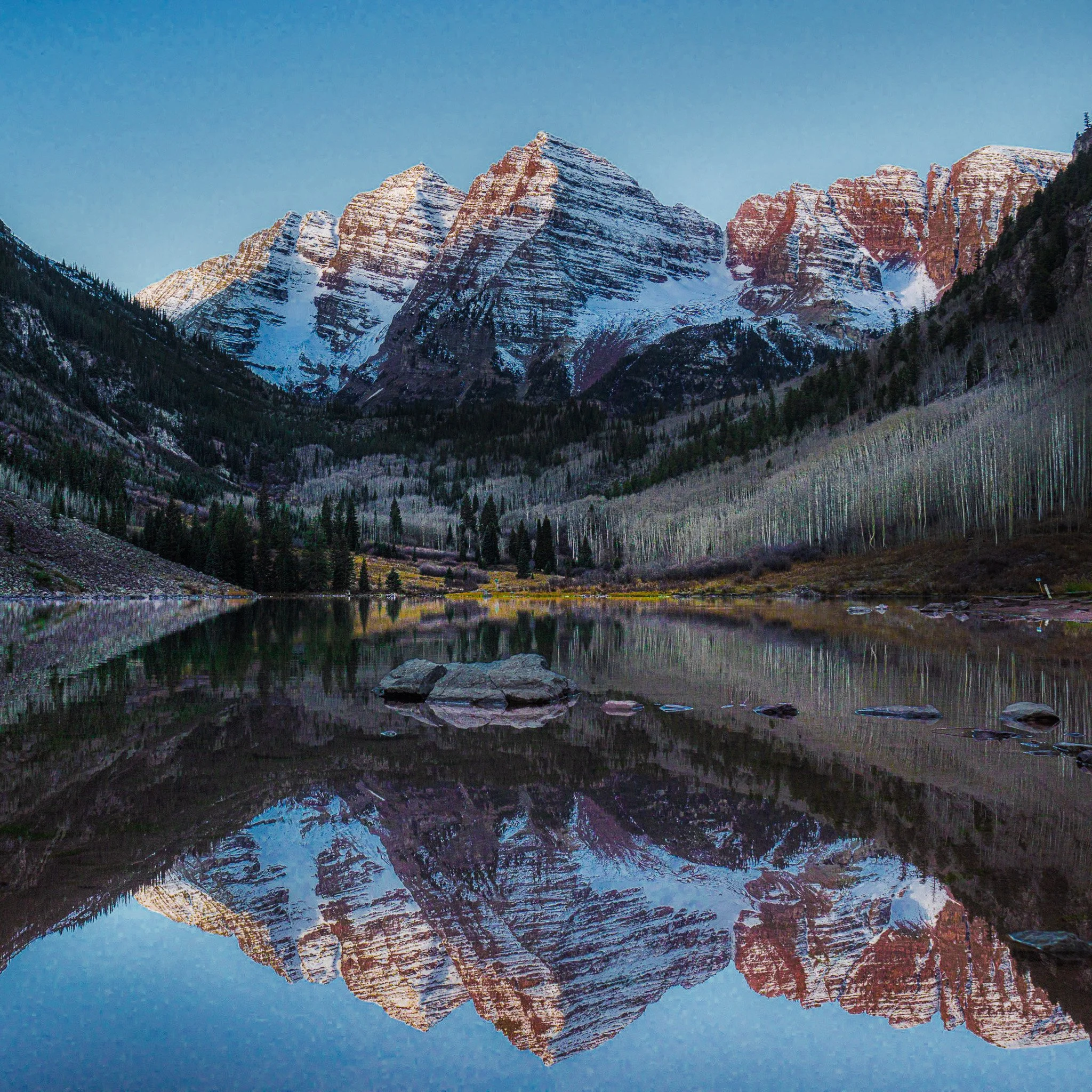
First golden light hits the snow-dusted peaks of the Maroon Bells above a mirror-still Maroon Lake, Aspen, Colorado
Colorado’s most photographed peaks
A good landscape tip doesn't always come from a guidebook or a photography forum; this one came from my youngest daughter. Years ago, while working as a nanny for a Bay Area family who also kept a place in Aspen, she spent her early morning free time walking the trails around Maroon Lake. She noticed a daily ritual along the shoreline: a row of tripods planted along the shore before dawn. She told me I had to see it for myself. When I finally made the trip to Colorado's Elk Mountains, it took about ten seconds to understand why locals are so protective of the view. Rising sharply above the glacial valley are Maroon Peak and North Maroon Peak—two jagged fourteeners sculpted from ancient, iron-rich sedimentary mudstone that gives the rock its signature rust-red hue.
Bluebird Skies and Glassy Water
I arrived along the shore well before sunrise, claiming a spot during the quiet chill of blue hour. As any landscape photographer knows, you pack your bags hoping for dramatic storm clouds, swirling mist, or fiery atmospheric color, and Mother Nature occasionally hands you a completely cloudless bluebird sky instead. Rather than pack up and sulk, I settled in for a couple of hours to watch the light work. At 9,580 feet of elevation, the morning air was dead calm, turning Maroon Lake into an almost unbroken mirror. As the sun crept over the eastern ridge behind me, warm golden light touched the snow-dusted summits first, gradually sliding down the striated cliffs until the entire basin glowed and doubled itself in the still water below.
Why We Always Go Back
Since that morning 11 years ago, popularity has caught up with the valley, and visitors now need advance $10 private vehicle parking pass or $16 shuttle reservations just to reach the lake before sunrise. Even with the bluebird sky, the symmetry of those peaks framed by leafless white-barked aspens and dark evergreens made the early arrival worthwhile. Still, I find myself itching to return when a passing weather front puts some drama in the sky. After nearly fifty years of doing landscape photography, the biggest lesson I have learned is simple: you have to keep going back to the same places. Conditions never repeat themselves, and every return trip usually hands you a completely different mood.
Where the Trail Wanders On

Joshua Tree National Park is famous for its quirky namesake trees and massive boulder piles, but a lone California juniper bathed in last-minute golden hour sidelight stole the show during this moody desert evening.