
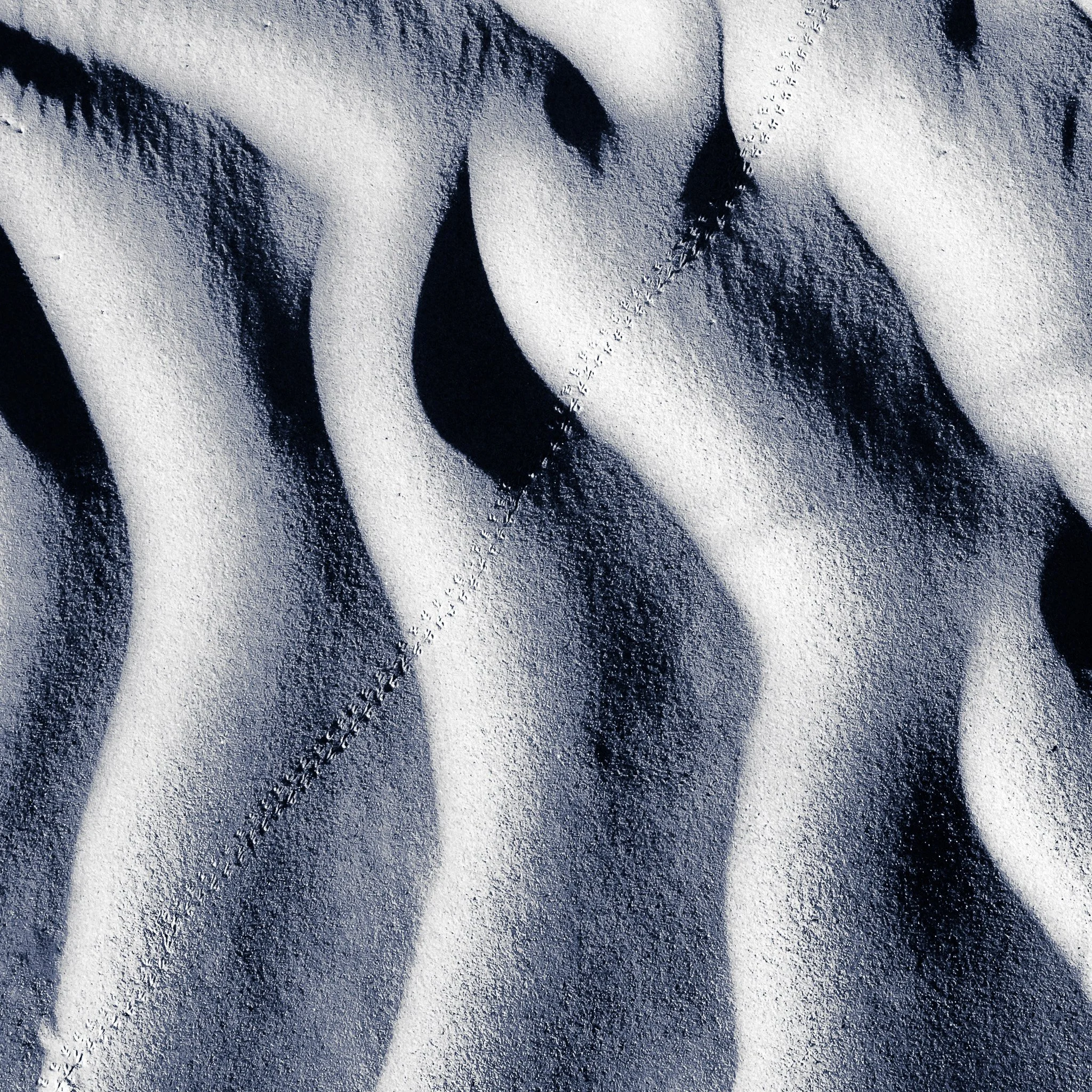
A minimalist black and white look at the wind-sculpted ridges and textures of Eureka Dunes in Death Valley National Park.
Photographing Eureka Dunes: Abstract Textures in Death Valley
Isolated deep in the northern reaches of Death Valley, Eureka Dunes stands out not just for its massive height, up to 680 feet above the valley floor, but for its pristine, wind-sculpted details. Before upgrading my adventure/on-location-landscape-photography vehicle to my current campervan setup, I took my Jeep out to this remote corner of the park during the winter months. While the daytime temperatures made for perfect exploring conditions, the desert nights were a completely different story—dropping down to freezing and making a night's sleep in the back of the Jeep a chilly, unforgettable endurance test.
The payoff image of this trip for me came in the clean light of day. I captured this abstract view using my Olympus E-M1 paired with the 40-150mm f/2.8 Pro lens extended fully to 150mm (300 mm equivalent). Opting for a telephoto lens allowed me to isolate the high-contrast ridgelines and intricate wind ripples carved into the sand, stripping away the scale of the massive dunes to focus purely on form, light, and shadow. Yes, there are a few footprints at the bottom of the frame, but I opted to not remove them and just leave them for scale of the size of these dunes.
Shooting at 1/5000 sec and f/2.8 at ISO 200 kept the fine textures sharp while cutting through the bright desert glare of midday. Converting the image to a stark black and white emphasizes the geometric perfection of the landscape, turning a harsh, unforgiving environment into a quiet study of natural minimalism.
Explore more of my adventures

Discover the story behind capturing a sudden rainbow over Mitre Peak from Skyline Drive in West Texas before a night of deep-sky astrophotography.