
SANDSTORM AT MESQUITE FLAT DUNES
Death Valley sandstorm
GOLDEN HOUR IN A DEATH VALLEY HABOOB
SURVIVING THE WIND AND CAPTURING THE DUST AT MESQUITE FLAT
There is a distinct moment in Death Valley when the atmosphere shifts from serene desert quiet to absolute chaotic fury. I have been sandblasted twice in this national park, and both times it happened at the Mesquite Flat Sand Dunes. This particular haboob struck right during golden hour, transforming the soft, undulating landscape into a blinding wall of glowing amber dust. Standing in the teeth of a gale, feeling fine grains of silica attempt to exfoliate my skin through two layers of clothing, you quickly learn what your gear—and your patience—is made of.
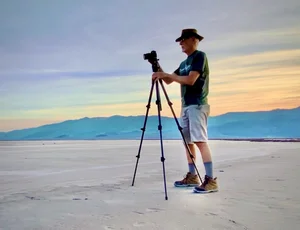
Changing lenses in a dust storm like this is an absolute non-starter unless you want your camera body turned into a pepper shaker. You shoot with whatever glass is already mounted, tighten your tripod legs, turn your back to the wind, and shield the front element between frames. The sheer volume of blowing sand obscures the background ridges, diffusing the late-afternoon sun into a thick, luminous haze. The light wraps around the crests of the dunes, catching the airborne particles and illuminating the blowing sand plumes as they slice across the ridges.
Mesquite Flat is the most accessible dune field in Death Valley National Park, surrounded by towering mountain ranges that trap and channel winds through the valley floor. The dunes themselves are formed primarily from quartz sand eroded from the surrounding cottonwood mountains, held in place by mesquite trees that anchor the margins of the field. During high-wind events, the sand transport is so severe that entire dune crests shift within hours, completely reshaping the terrain and erasing every footprint left by daytime visitors.
Capturing an image like this requires working quickly before the dust chokes out all remaining contrast. In post-processing, balancing the warm orange hues without blowing out the highlights where the sun pierces the dust is critical. A touch of local contrast enhancement helps define the subtle layers of windblown sand while preserving the ethereal, atmospheric quality of the storm. It was rough on the equipment and even rougher on the eyes, but moments like these are why we venture out into the wild spaces.
Explore More of My Adventures
Standing inside a Death Valley haboob during golden hour turns the desert into a glowing, sandblasted furnace. Here is the story behind capturing the storm at Mesquite Flat Dunes.