
Winter Quiet Over Canyonlands National Park
Cold Curves of the White Rim Bench
Cold Winds and Deep Geology at Island in the Sky
Finding High-Contrast Beauty When the Sky Refuses to Cooperate
Winter in the desert has a funny way of checking your motivation. After pulling into my campsite at Canyonlands National Park, the weather turned into a wall of biting wind and heavy overcast skies. It was the kind of nasty, gray afternoon where you could have easily twisted my arm and talked me into staying in the warm Sprinter van with a hot cup of coffee. But over the years, I’ve learned that the standard "golden hour" sunset isn't the only time the landscape speaks. More and more, I like to venture out at the times other people pack it up. That’s usually where the mood lives, and it’s where I seem to capture my best work.
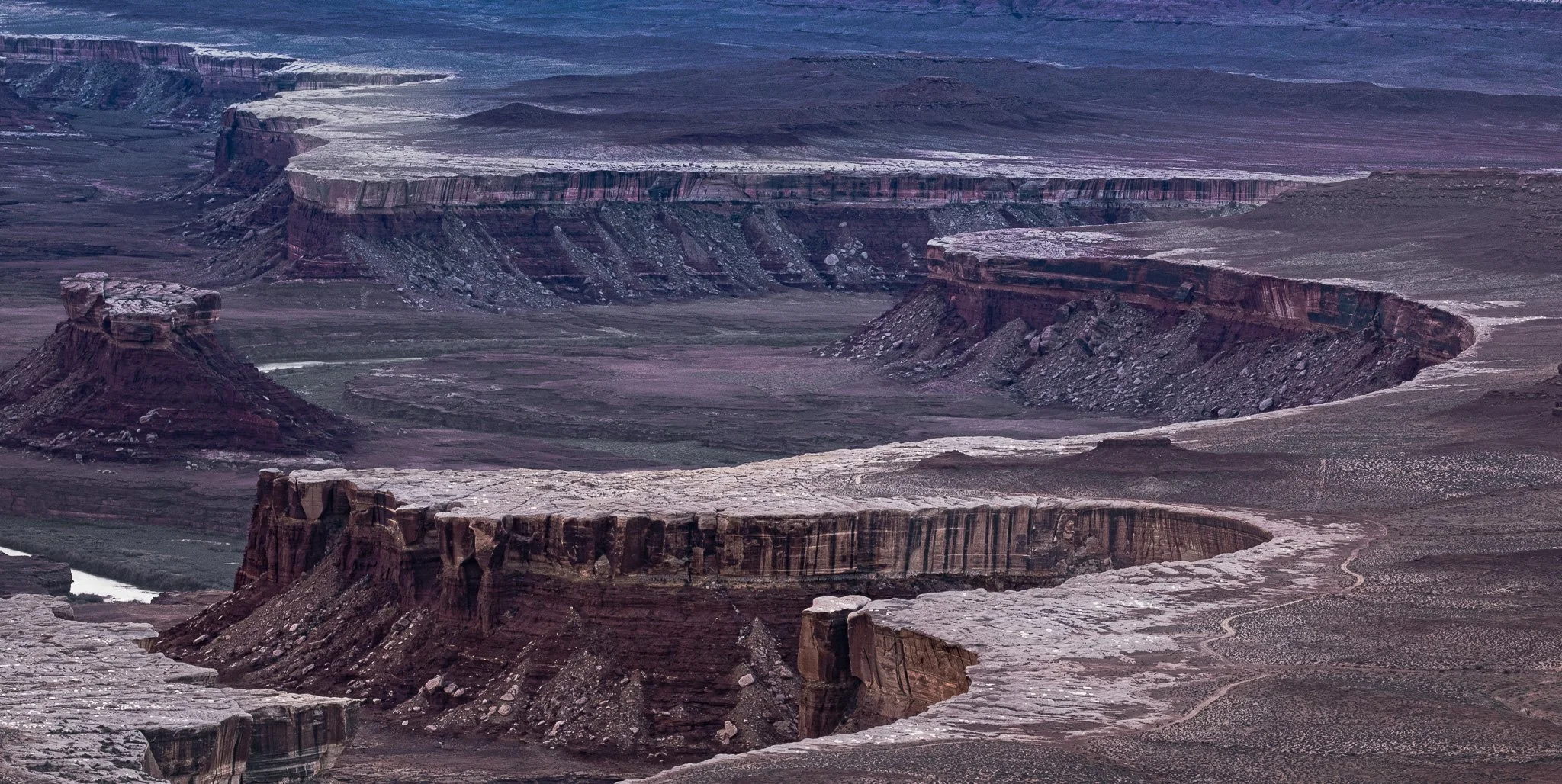
Aside from one couple at the viewpoint who didn't stick around long, I had the vast expanse of the Island in the Sky district completely to myself. Setting up the tripod into a stiff winter gale isn't ideal, but locking down the OM-1 with the 12–100mm f/4 PRO lens gives me total confidence. Zooming into 70mm, I isolated this incredible curving section of the canyon bench below. Without a blazing sun to create harsh highlights, the muted, flat light actually worked in my favor—it brought out the sheer depth, dramatic scale, and raw textures of the rock layers without fighting high-contrast shadows.
The star of this view is the famous White Rim Sandstone, an ancient coastal dune complex deposited roughly 275 million years ago during the Permian Period. Interestingly, while most sandstones across the Colorado Plateau retain a deep red or orange hue from iron oxide, the White Rim layer was chemically "bleached" tens of millions of years later when subterranean hydrocarbons migrated through the porous rock, stripping away the iron. Because it is far harder and more erosion-resistant than the soft shale layers beneath it, it acts as a protective caprock, carving out vast flat benches 1,200 feet above the river floors.
If you look closely at the lower right corner, you can see a faint dirt track hugging the edge of the abyss. That’s the famous 100-mile White Rim Road, originally carved out by miners during the 1950s Cold War uranium rush. Seeing that tiny ribbon of dirt tracing the massive sandstone bench really puts the staggering, ancient scale of this canyon into perspective. I haven't taken a 4WD vehicle down there for that overland adventure yet, but seeing it from above certainly plants the seed.
When you strip away the golden light, landscape photography becomes pure composition, geology, and spatial awareness. Cold fingers and a howling wind are a small price to pay for having one of North America's most staggering geological wonders entirely to yourself.
Explore More of My Adventures
Standing inside a Death Valley haboob during golden hour turns the desert into a glowing, sandblasted furnace. Here is the story behind capturing the storm at Mesquite Flat Dunes.