
Solitude Near Rhyolite: A Vanlife Refuge Just Outside Death Valley
Finding Quiet, Dark Skies and Free BLM Camping in Nevada’s High Desert
The Secret to Staying Outside Death Valley
Anyone who has spent time exploring Death Valley National Park knows two things very quickly: the landscapes are unbelievable, and the gas prices inside the park will make your eyes water. Every time I trip through Daylight Pass toward Beatty, Nevada, my first stop is the gas station to fill up at roughly half the price offered at Furnace Creek. And the gas station at Stovepipe Wells doesn’t even have diesel fuel. But the real treasure of this route isn't just cheaper fuel. It's the vast expanse of open public land stretching across the Amargosa Desert. Just a fraction of a mile off the main highway lies one of my absolute favorite boondocking spots, where the desert floor spreads out beneath pointy sun-drenched peaks and absolute silence reigns.
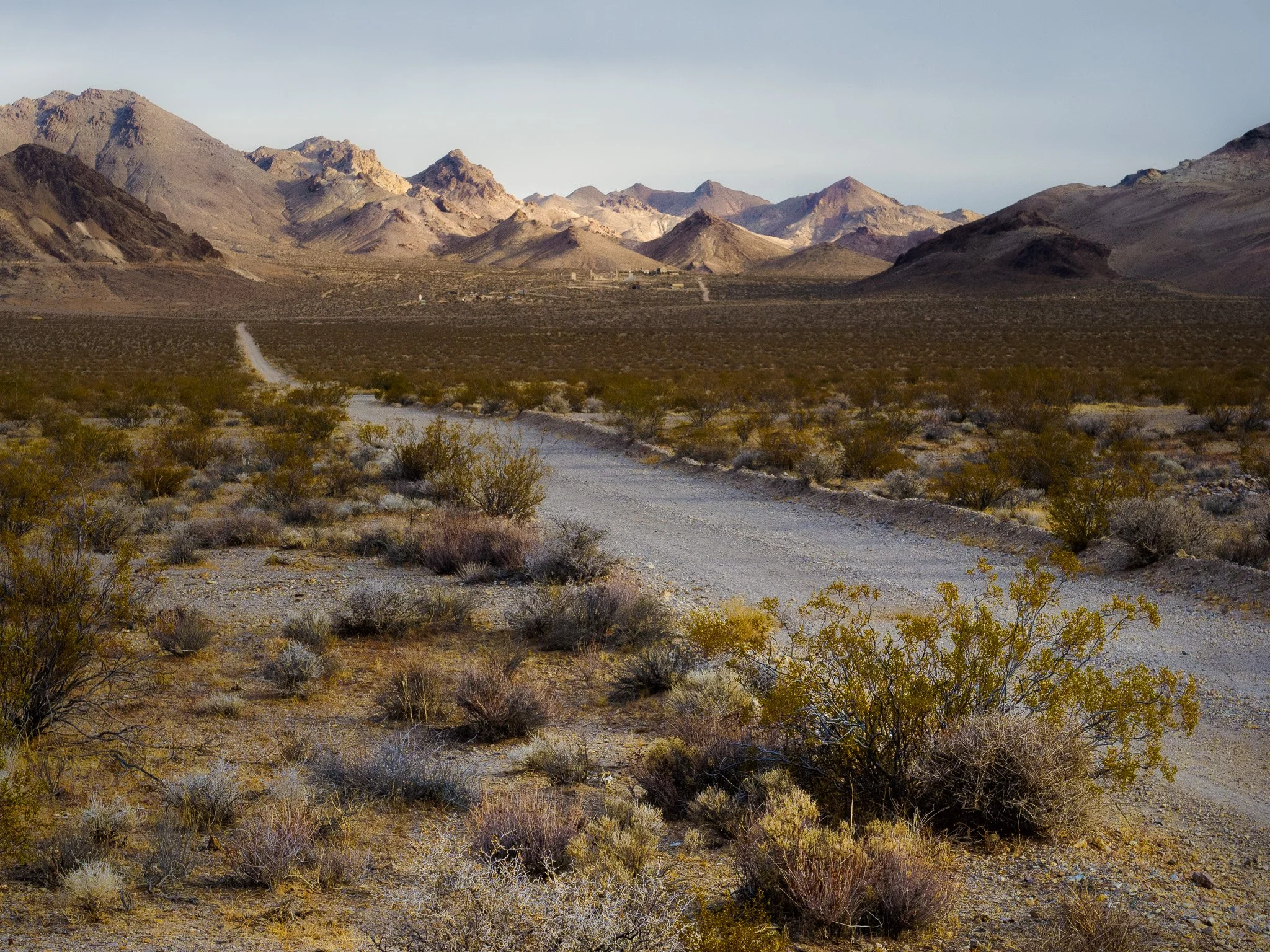
This well graded dirt track cuts straight through desert scrub toward the rugged Bullfrog Mountains in the distance. If you look closely near the base of those hills, you can catch a glimpse of Rhyolite, one of the West's most famous ghost towns. Rhyolite boomed almost overnight in 1905 after prospectors discovered gold in the hills, quickly growing into a bustling city with electric lights, a three-story bank, and even an opera house. By 1912, the ore ran dry, the financial panic took its toll, and the town was abandoned just as quickly as it rose. Today, stone ruins and quiet gravel roads are all that remain, serving as a reminder of how fast the desert reclaims its territory.
Framing the High Desert Landscape
From a composition standpoint, shots like this rely heavily on leading lines to pull the viewer across the frame. I used the dirt road as a natural path for the eye, guiding it from the detailed foreground brush all the way toward the alluvial fans and quirky mountain peaks on the horizon. The soft, early morning side lighting accentuates the texture in the desert vegetation and carves out deep shadows across the mountain slopes. To capture this depth without distorting the distant mountains, I selected my 12-40mm f2.8 Pro lens at 40mm focal length and f7.1. That compressed the scene nicely, keeping the rugged background prominent while retaining the intimate feel of the desert foreground. Going to higher f stops than 7.1 on my MFT system, in my experience, isn’t necessary or useful and can begin to cause diffraction. ISO was native 200.
The Dream Spot for Vanlifers and Night Sky Photography
What makes this specific location truly special is the complete lack of noise and light pollution. Camping out here on free Bureau of Land Management (BLM) land gives you strong cell service from nearby Beatty, a smooth dirt access road, and zero pass-by traffic through the night. Once the sun drops behind the mountains, the dark sky comes alive, making it an incredible launching pad for night photography and star tracking. Whether you are staging for early morning light in Death Valley or spending the night under a blanket of desert stars, spots like this capture the essence of western freedom.
Explore More of My Adventures
After passing it for years on I-680, commuting from Danville to Pleasanton, I finally pulled off the freeway to photograph the historic 1877 David Glass House in dramatic black and white.