Desert Prism
Catching a double sun dog over the gypsum dunes. There is something absolutely surreal about the way the light hits the sand at White Sands National Park. It feels less like Earth and more like a dreamscape.
The Evening I Saw Three Suns: Capturing a Sundog over White Sands
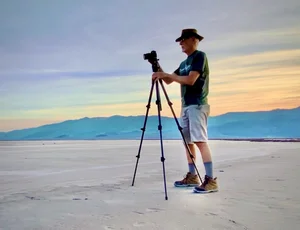
White Sands National Park is a place where reality feels suspended. The dunes are alabaster, the air is thin, and the shadows stretch out like long, cool fingers across the gypsum. A few years back, I found myself in the desert during a photography workshop, waiting for sunset. We were a quiet collective, spread out across the silent ripples in the sand, our tripods ready, praying the flat, hazy sky wouldn't deliver a boring evening.
Our instructor, a seasoned landscape veteran, had reminded us: "Sometimes the most interesting light happens in the haze, not in the clear blue."
I wandered far from the group, looking for a composition that felt solitary. I found these sparse clumps of yucca plants, their needle-thin blades a sharp contrast to the soft texture of the sand ripples. I settled low, framing the foreground to provide leading lines into the vast sweep of the dune field toward the distant mountains. The light was golden, diffuse, and lusciously warm.
As the sun continued its descent, something magical clicked into place.
The sky wasn’t just haze. The ice crystals in the upper atmosphere were performing a cosmic trick. What began as a soft glow suddenly fractured. It wasn't just one sun. Shimmering symmetrically on either side, painted with subtle spectral golds and pale blues, were two clear, unmistakable sundogs—a phenomenon known as parhelia. The ice crystals were bending the light like a prism, giving the desert a triple-sun canopy.
I dropped my camera lower, almost to the sand, realizing this fleeting event needed depth to ground it. The composition had to anchor that miraculous sky. I captured this image just before the left sun dog started to lose its intensity, a perfect balance between the otherworldly sand floor and the rare, celestial event unfolding above it.
That workshop evening was a lesson in patience. You don't always get the postcard sunset, but if you look past the obvious, White Sands might just give you a memory of the cosmos bending the light. This photograph remains one of my most cherished captures, a fleeting glimpse of the spectacular intersection between a white desert and a triple sun.